

01 / START WHERE YOU ARE
An idea. Or your next chapter.
Start fresh, connect a local or GitHub repository, or bring one as reference.
AGENT CONTROL CENTER BETA
Bring an idea or an existing project. Coordinate planning, design and development—with your project’s files and decisions keeping the work connected.
Free ACC access for accepted beta users. Future pricing is undecided.
 Repository
A simpler start for your customers.
KEEP THE BIGGER PICTURE
A new agent shouldn’t mean another round of explaining everything.
ACC connects work to your project files and recorded decisions, helping the next task pick up the relevant background.
See how context carries forward FilesThe conversation changes. The decision stays connected.
YOUR DIRECTION. COORDINATED WORK.
Plan it with a manager agent. Let your agents handle the tasks. Review the results and decide what comes next.
Start fresh, connect a local or GitHub repository, or bring one as reference.
Discuss the work with a manager agent and review the plan before implementation.
Choose what can run automatically. Review results, answer decisions and request changes.
BUILT WITH ACC
We built ACC to get back to building GetSet. Today, we use it to plan, coordinate, review and improve ACC itself.
The work includes corrections and human decisions. Each improvement makes the system we rely on more useful.
Read the building storyReview holds were connected to a visible decision queue, with corrections to how approval releases work.
ROOM TO BUILD YOUR WAY
Choose the team and the level of oversight that fit your project. Stay involved where your judgement matters.
 Gemini
 Claude Code
 Codex
CodexGive agents different roles and AI tools. Bring in human collaborators when you need another perspective.
Explore tools and setupLet configured work proceed, ask for reports and step in to change direction. You decide what needs your approval.
See how supervision worksThe execution machine must stay online.
KEEP YOUR WORK WITHIN REACH
Open ACC in your web browser—on a laptop, tablet or phone. Run supported work on your computer or a connected VPS, then check progress and respond from another device.
A laptop that sleeps can’t keep running tasks. Use an available dedicated machine when you want work to continue.
Check what you needA PROJECT YOU CAN KEEP
Your project files and the document-context records that accompany them stay with you, so you can continue working outside ACC.
Some coordination data is stored by ACC. Personal exports, organization-owned work and account deletion have different coverage. Read the data guide before choosing what to keep or remove.
Understand what is stored whereACC also holds coordination data.
A separate GetSet tool for exploring and editing project memory as a connected graph.
Need a capability? Request it. Your feedback helps us understand what would make ACC more useful for your work.
Beta access
Bring the idea you keep coming back to, or the product you’re already building. Apply for the free ACC beta. Setup support is available.
Check your inbox for a confirmation email. We’ll review your request and get back to you within 3–4 days.
Applying does not create an account or grant beta access.
Your answers are still in the form. Please try again. If this continues, contact support@getset.live.
Yes. ACC is designed for solo founders and small teams. Start on your own and invite human collaborators as your project develops.
Technical familiarity helps with setup and reviewing work. You can discuss the plan with a manager agent, and beta setup support is available. Onboarding is still being improved.
Yes. Connect a local or GitHub repository to build on it, or use one as reference. Explain which parts can change and which decisions must stay in place.
ACC access is free for accepted applicants. You supply your own supported AI subscriptions or API credits and pay for any VPS or other hosting you use. Future ACC pricing is undecided.
Yes. Agents can make mistakes. ACC helps coordinate records, tasks and decisions; your judgement and review remain part of the process.
The tour
Harbor is an example product — a B2B onboarding tool. Its founder, Priya, wants a customer-onboarding flow: invites by email, a three-step setup wizard and a checklist. Here is how that request moves through ACC. Scenes are simplified representations of ACC, with illustrative project data. This example uses GitHub; you can also start with a local repository.
A normal chat message in the Workspace — no template, no ticket.
Build a customer-onboarding flow: invite teammates by email, a three-step setup wizard, and an onboarding checklist on the dashboard. Ship it behind a feature flag.
I'll draft a plan. Using the project record and DEC-014 (new features ship behind the flag() helper). Expect five tasks in three waves — you can revise before anything runs.
What's happening. Because the project record and earlier decisions live in ACC, the agent can respond with relevant context. The chips show exactly what it was given.
Tasks, responsibilities and the order of work — readable before anything runs.
What's happening. Waves are the order of work: tasks in the same wave can run together; a wave starts when the one before it has landed. Change your mind later and an approved plan can be pulled back.
Specialists take their tasks. Independent work runs together; dependent work waits.
What's happening. Two agents work at once on tasks that don't depend on each other, each on its own runner. The “waits on” chips say exactly what T3 and T4 are waiting for.
The design is ready, so the developer can pick up the next task — without anyone pasting anything between tools.
What needs you lands in one Inbox: approvals, questions and review asks.
What's happening. Reviews come back as summaries you can act on. The drawer shows where T3 is in its lifecycle and what it depended on. Pause, steer or reassign a running task without losing its work.
Two weeks later, a new task touches invites. The record is already there.
Scheduling the reminder for day 5 — two days before the 7-day expiry in DEC-021 — and sending it through lib/mail so the unsubscribe footer is added.
What's happening. Relevant items are selected for the task at hand, ranked, de-duplicated and kept within a fixed budget. This is project memory — not training of the underlying AI models.
Apply for the beta, or check what you need to get set up.
THE GETSET BUILDING STORY
ACC began as an internal tool to help a founder keep an ambitious product moving. It became a product of its own.
GetSet started with a vision for a service coordination platform. Across teams, tools and iterations, too much of the founder’s time went into explaining decisions, reconnecting context and coordinating implementation.
AI agents brought new possibilities, and new friction: scattered conversations, repeated mistakes, connection failures and work spread across machines. ACC grew out of the effort to make that work easier to direct.
Today, the founder uses ACC to plan and coordinate ACC’s own development, with agents implementing work and people reviewing decisions and corrections. The same approach supported FlowGraph, built by an intern under the founder’s close supervision.
The founder now uses ACC to continue building GetSet, including automated work on a VPS that returns decisions for human input.
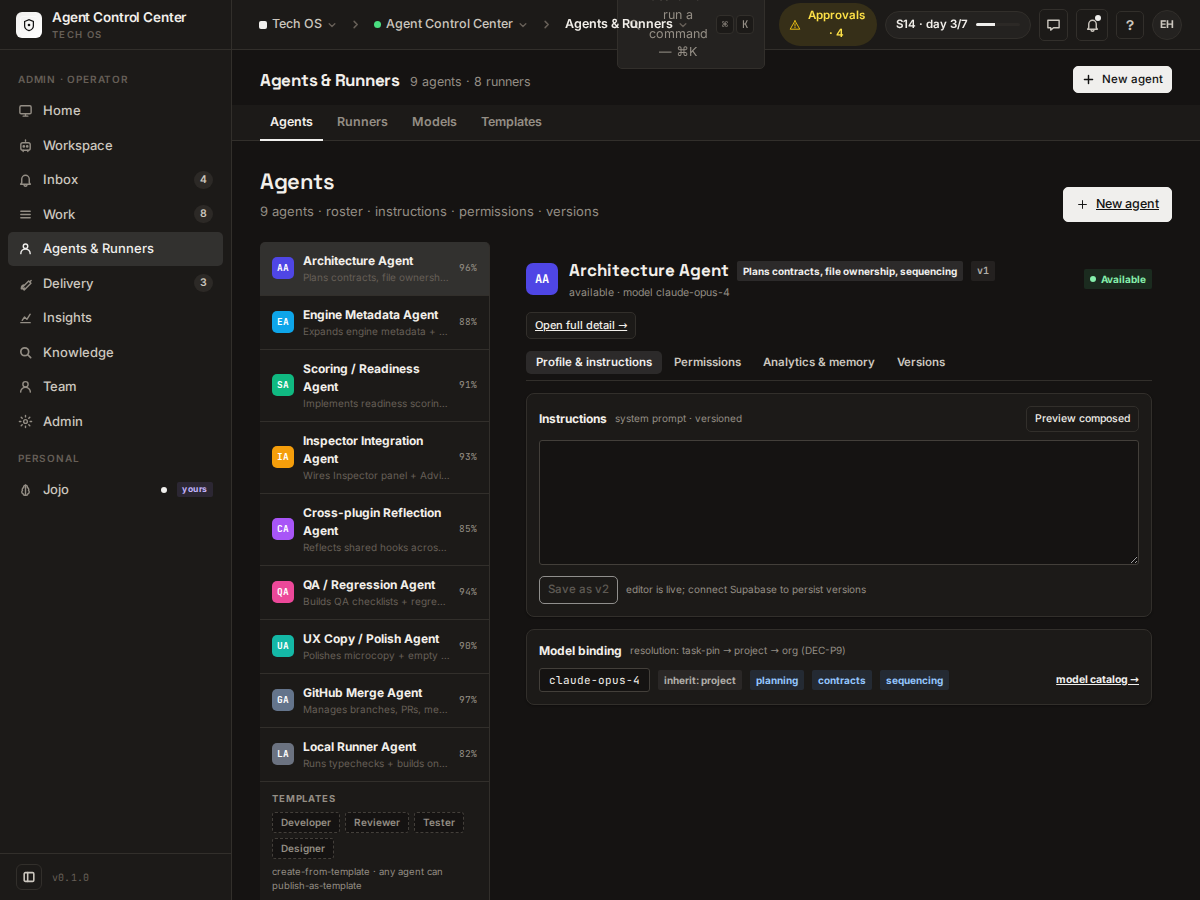
WHAT THE RECORD SHOWS
Selected merged changes from ACC’s September 2026 development history.
A pre-PR conformance gate added checks for mechanical issues before work reached the pull-request stage.
Request-budget and merge-workflow changes went through revisions around scope, review constraints and tests.
Review holds were connected to a visible decision queue, with corrections to how approval releases work.
Based on a review of the private repository on 7 September 2026. These examples show recorded implementation and rework, not guaranteed outcomes or fully autonomous development.
Explore how ACC works